In materials science and engineering, computational modeling is becoming as critical as experimental work. Today, we can predict the mechanical behavior of a new alloy, the electrical properties of an oxide, or the stability of rare-earth elements in solution through computer simulations.
But where should a newcomer begin? Here’s a roadmap:
1. Understanding the Basics: Why Simulation?
Modeling supports experiments, reduces costs, and reveals what is otherwise invisible.
- Before experiments: Which systems are promising?
- During experiments: Optimize parameters.
- After experiments: Explain and generalize findings.
Simulation allows you to “see in computation” what you cannot directly measure in the lab.
2. Which Method? A Decision Tree
The most important question for beginners: “At which scale is my problem?”
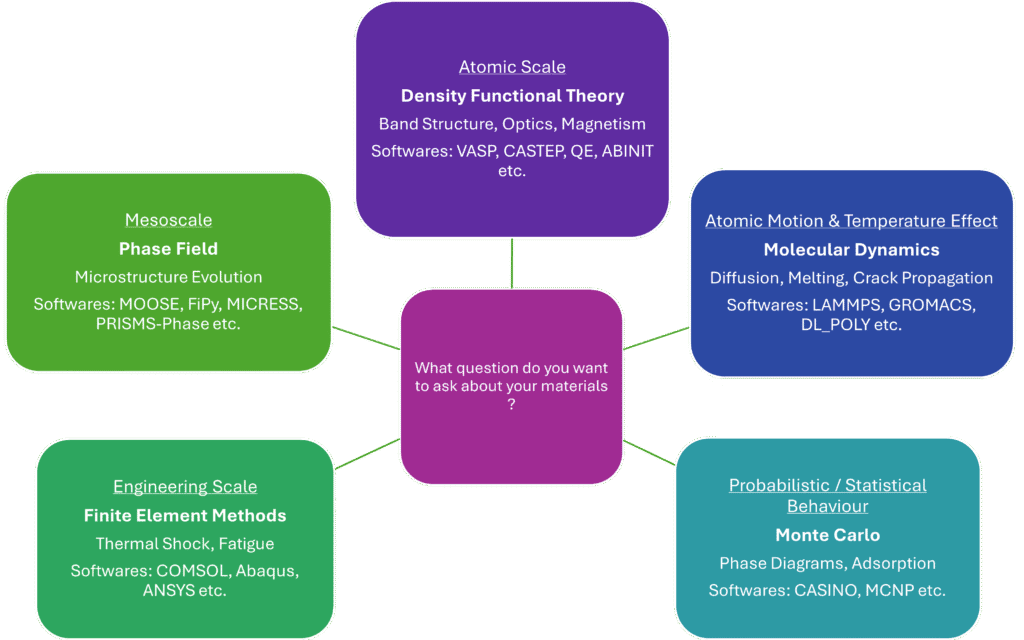
👉 There is no single “correct” method. First, choose the scale that matches your question, then move on to the appropriate software.
3. Getting to Know the Software
Popular tools exist for each method:
- DFT: VASP, CASTEP, Quantum ESPRESSO, ABINIT
- Molecular Dynamics (MD): LAMMPS, GROMACS, DL_POLY
- Phase-Field: MOOSE, FiPy, MICRESS, PRISMS-PF, OpenPhase
- Monte Carlo (MC): CASINO, MCNP, Python libraries
- Finite Element Method (FEM): COMSOL, Abaqus, ANSYS
For beginners, it is best to start with open-source packages or whatever software is available to you and test it on a small system.
4. What Infrastructure Do You Need?
- Personal computer: For small tests and learning purposes.
- Workstation / HPC cluster: For large-scale, publication-quality simulations.
Most researchers begin by practicing on a personal computer, and later move serious calculations to high-performance computing facilities.
5. Building Your Library
Some foundational books will guide you as you learn:
- Sholl & Steckel, Density Functional Theory: A Practical Introduction
- Allen & Tildesley, Computer Simulation of Liquids (a classic for MD)
- Binder & Heermann, Monte Carlo Simulation in Statistical Physics
- Ashcroft & Mermin, Solid State Physics
- Zienkiewicz et al., The Finite Element Method (fundamental FEM reference)
6. Drawing Your Own Roadmap
- Step 1: Pick a simple model system (e.g., Al crystal, Si semiconductor, NaCl ionic solid).
- Step 2: Run a basic calculation (geometry optimization, short MD simulation, simple FEM analysis).
- Step 3: Visualize the results (DOS, MSD, temperature profile, stress distribution).
- Final step: Apply the method you learned to your actual research problem.
7. Final Words
Modeling and simulation may seem overwhelming at first. But once you proceed step by step, it becomes a journey that both strengthens your experiments and expands your scientific perspective.
As a common saying in engineering goes:
“Those who only observe, only see. Those who calculate, understand.”
By starting with modeling, you can truly deepen your understanding of materials.
